
Theory of Change
Theory of change is a planning and evaluation method that helps to map out what an organisation needs to do to achieve a long-term goal – and how it can be done.
The “So What?” Test: Connecting Action to Impact
One of the simplest and most powerful tools in a theory of change is asking “so what?” at every step. It acts as a reality check, pushing organisations to look past what they do to why it actually matters.
From outputs to outcomes
Organisations often measure success by counting outputs. Asking “so what?” shifts the focus to the real-world difference those activities make. Why are the outputs important? What are the benefits and what will be the long-term impact?
Challenging assumptions
Every plan relies on assumptions about how change happens. If you struggle to answer “so what?” between one step and the next, it’s an opportunity to delve deeper into your thinking about how and why an activity triggers an action.
Building a clear case for support
Funders, stakeholders, and partners want to invest in the difference an activity makes, rather than the process itself. Using the “so what?” test turns operational lists into a clear, compelling story of meaningful impact.
At Devon Communities Together we have developed our own Theory of Change, which you can see below, and often work with other organisations to support them to develop theirs. Despite ending up with a concise document, creating a Theory of Change can demand many iterations and collaborative input from a range of stakeholders.
We regularly run Theory of Change training sessions that help to upskills organisations in this area, which can transform they way they plan their activities and provide invaluable when it comes to evaluating their impact.
The benefits of using a theory of change include:
Clear planning
Helping determine why an action may lead to a result, rather than just hoping or guessing
Insightful evaluation
A Theory of Change is like a roadmap where you can check in at each step to see if it’s working
Aligning stakeholders
Whether it’s your own staff team, trustees, volunteers, funders or partners, everyone can buy into the same path to create impact
Our own Theory of Change
Below you can see the Theory of Change we developed for our own charity, with the roadmap leading to the fulfilment of our strategic aims.
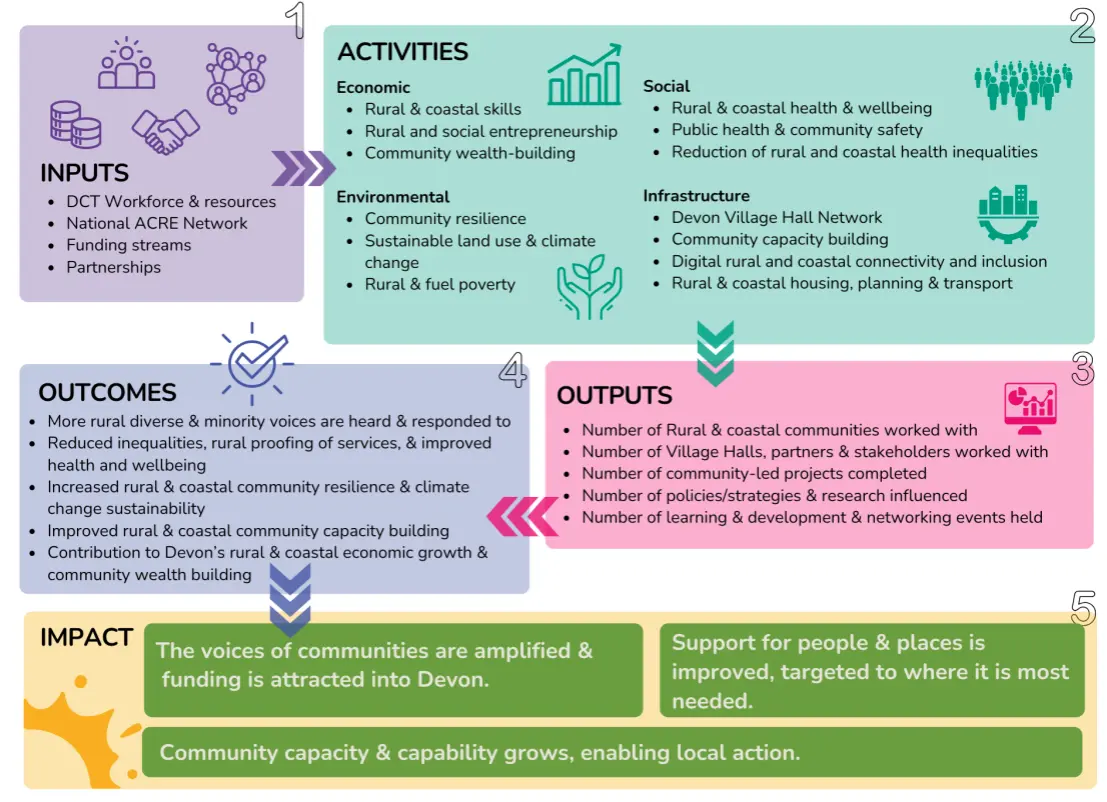
Read our Theory of Change as text
1. Inputs
- DCT Workforce & resources
- National ACRE Network
- Funding streams
- Partnerships
2. Activities
Economic
- Rural & coastal skills
- Rural and social entrepreneurship
- Community wealth-building
Social
- Rural & coastal health & wellbeing
- Public health & community safety
- Reduction of rural and coastal health inequalities
Environmental
- Community resilience
- Sustainable land use & climate change
- Rural & fuel poverty
Infrastructure
- Devon Village Hall Network
- Community capacity building
- Digital rural and coastal connectivity and inclusion
- Rural & coastal housing, planning & transport
3. Outputs
- Number of Rural & coastal communities worked with
- Number of Village Halls, partners & stakeholders worked with
- Number of community-led projects completed
- Number of policies/strategies & research influenced
- Number of learning & development & networking events held
4. Outcomes
- More rural diverse & minority voices are heard & responded to
- Reduced inequalities, rural proofing of services, & improved health and wellbeing
- Increased rural & coastal community resilience & climate change sustainability
- Improved rural & coastal community capacity building
- Contribution to Devon’s rural & coastal economic growth & community wealth building
5. Impact
The voices of communities are amplified & funding is attracted into Devon.
Support for people & places is improved, targeted to where it is most needed.
Community capacity & capability grows, enabling local action.
Would you like help to create something similar?
Please contact us to see how we can help.
Contact Us